

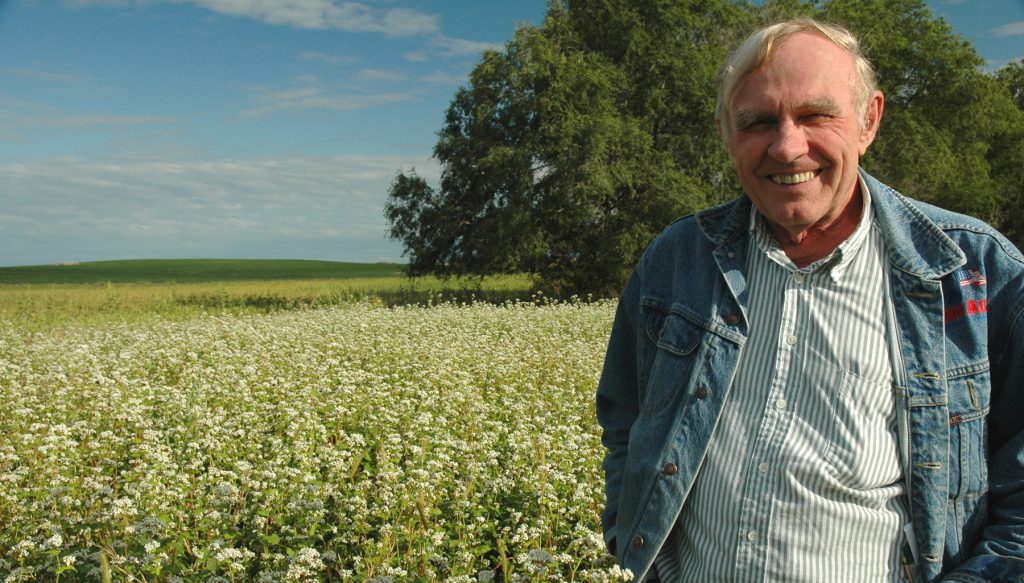
Fred Kirschenmann has been an agent-of-change in agriculture for five decades.  His work at the Leopold Center at Iowa State University has introduced resilient farming practices to diverse stakeholders, and advanced the adoption of regenerative land management through building an awareness for soil health in the US breadbasket.
.

LAND USE ADAPTATION – Scaling Regenerative w/ Soil health

episode 102:  Fred Kirschenmann || Regenerative Soil Health in Food Production

As President of the board at Stone Barns Center for Food and Agriculture in Tarrytown, NY, Fred has worked with leaders from cuisine, food systems and production agriculture to establish a globally recognized epicenter of research and enrichment for food.  As a whole, Fred’s collective efforts to reconnect us with nature through food and its production elevates him to an iconic stature in a time of ecological enlightenment.  Tune in to hear what this true-action-hero icon has to say about the movement in 2022 and beyond.
.

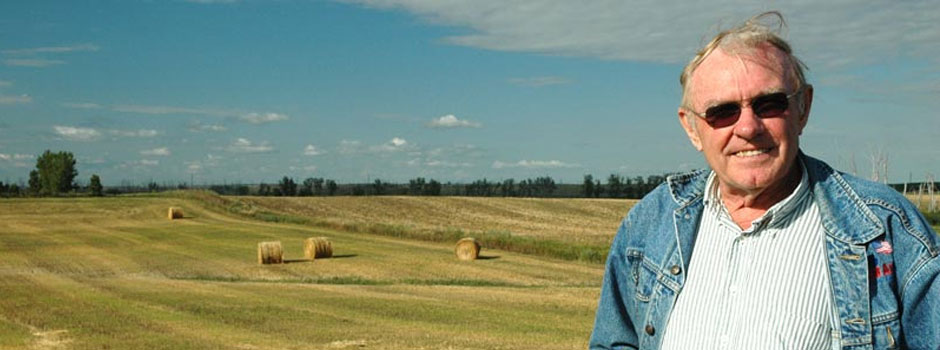
A statesman for a just and stable tomorrow.  Every-time I sit down with Fred I learn something new.  He’s a philosopher and master craftsman of storytelling that has inspired many of us in the movement to take next steps in our own journeys.  Despite holding multiple jobs, overseeing hundreds acres of farmland, and shouldering the weight of the world well into his 80s, Fred remains current on advancements and bleeding-edge research.   Leveraging an impressive compendium of readings and on-going discussions with other iconic thought-leaders – Fred is a wealth of knowledge who continues to mold and sway new mindsets. This type of inspiration from action heroes like Fred serves up quality nourishment for the movement, and fuels deeper engagement.

.

When I first stewed over the startup idea to coax food values through the supply chain, Fred coached me to think systematically and to adapt my focus to incorporate different stakeholders in the equation.  He challenged me to include soil health, regenerative land management practice and regional food systems into a single frame that would focus on the betterment for all parties involved.  A decade later, we have a long way to go to reach betterment, but after sitting down and chatting with Fred in this latest end-of-2021 chapter, it’s clear that the revolution has begun.  IMO – what Fred has helped kindle over the last half century will reach a fever pitch within this next generation. I’ve seen first hand the inertia and passion of this generation to come. It’s real and it’s going to happen. Considering all of that, I’ve come to appreciate that how we produce our food and manage the living soil will ultimately determine the stability of the planet.

“Folks don’t follow new ideas alone. It’s the leaders of these ideas that motivates others to act; it’s people that drive movements.”

.

One thing is for sure, to stabilize this planet under threat we need to be do a better job listening to more of our iconic leaders – like Fred.  Folks who’ve lived-it; folks with real chops in delivering “betterment” to more.  For a more just and prosperous tomorrow, we need to listen to folks that know about instituting nature-based solutions.  The folks worth their salt; the ones with unique wisdom worthy of leading they movement are the action heroes who bring real solutions to the table.

.

An infomercial for Regenerative Agriculture & Soil Health, after hearing from an icon of food system and ecological change – be inspired to take the next step in your journey.

.


.

Key Take Aways…

EPISODE RECAP:

  • LAND USE: regenerative agriculture is proper on-farm natural resource management
  • HUMAN HEALTH: soil health harmonizes with gut health: microflora not too much different than soil
  • CIRCULAR ECONOMY: investing in soil health results in positive human & public health, planetary stability
  • LABOR: the future farming workforce wants to grow food for each other, and not commodities

WHAT GOOD SOIL OFFERS:

Soil is the lifeblood of every successful civilization.  The positive results and impact of good soil health from regenerative land management practices include:

  • Perpetual food production
  • Carbon Banking & Planetary Stability
  • No chemical and synthetic runoffs
  • Cleaner / health living environment for all stakeholders
  • Enhances nature and biodiversity
  • Sweet water Storage and clarity

GABE BROWN’S 5 PRINCIPLES OF REGENERATIVE:

To get us there we need a new operating model to land management.  Especially when it comes to the way we produce our food, we need a new operating model to land management.  Here are the pillars to support change our relationship with nature and each other.

  1. No disturbance (no-till, no-synthetics)
  2. Bolstering Soil’s Natural Defense (the outer-layer protecting all that life)
  3. Bio-diversity (marrying nature’s way keeps the system healthy)
  4. A living root in the ground as long as possible (cover-crops & seasonal diversity)
  5. Animal & Insect integration (nature relies on the entire system working together)

..

@StoneBarns


Sometimes you get lucky in life and come across truly inspirational people.  Pioneers of a new way of thinking that within their lifetime will impact the world.

I’ve come to realize that the factor that makes these individuals similar and yet so unique is that they’ve been through-it.  That despite what they encounter in their journey they demonstrate a dogged perseverance in their efforts of change.

“A gem cannot be polished without friction, nor an individual perfected without trials.”

Overcoming the pain, the failures, and the self-doubt gained in reaching key waypoints of change is what gives them capacity and the right to don a moniker of being an influencer worth their salt.  After all the hits, every-time they get-up to keep driving change forward.

.

When this kind of elbow grease bumps up against something that’s bigger than yourself; when influencers don’t become too salty in their pursuit of a mission to improve the human condition or that of the living planet; when these leaders  instigate a movement – that’s when we see the icons arise.  True Action Heroes that break-down parochial mindsets and evolve behaviors for the betterment of tomorrow actually exist. don’t breathe some kind of rarified air.  Despite being hard to find, these icons of environmental and social change live amongst us – in our times.  Influencers that we should follow, and real action heroes to be idolized.  The Icon series profiles these unique folks who inspire and influence change of mindset and behavior to re-chart more journeys ahead.

,.


photo credit:  Connie Fualk & Iowa Informer


.

LAND USE ADAPTATION – content series

Food produced using innovative REGENERATIVE ADAPTATIONS (like the solutions discussed in this miniseries) will instigate a whole new way of thinking. Eating good food shapes our relationship with nature for the better, and sustains the stomachs of those who influence mindsets well beyond agriculture fields. Demand for this food produced using elevated standards has already skyrocketed. In this series we connect with those in the US leading a paradigm shift towards smarter LAND USE with good food production.

.

for related discussions CLICK >>

.

.

.

.

.
Ep. 59: Bernie Rollin – author & Distinguished Professor of philosophy, animal sciences & biomedical sciences at Colorado State ||

.

Bernard Rollin is a distinguished professor of philosophy, animal sciences, and biomedical sciences at Colorado State University. Rollin is a leading scholar in animal rights and animal consciousness. Dr. Rollin has authored numerous influential books in the field, including Animal Rights and Human Morality (1981), The Unheeded Cry: Animal Consciousness, Animal Pain and Scientific Change (1988), Farm Animal Welfare (1995), and Science and Ethics (2006). Bernie joins us for episode 59: Our Animal Consciousness..
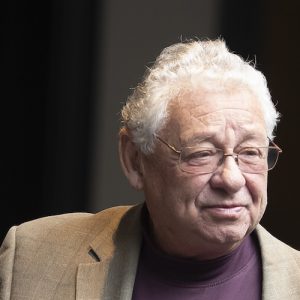
Bernie Rollin helped co-author the 1985 amendments to Animal welfare Act – which was originally signed into law in 1966 by Lyndon Johnson.  In our 45 minute discussion Rollin shares what has and hasn’t changed in the thirty year since penning the key amendments. The inclusion and awareness of Rollin’s work has change laws and practice relating to animal suffering in food production, laboratory work, and within societal norms. In the five decades he’s been at this – his work has literally aided hundreds of billions of animals.


.

Tune in to hear what this matter-of-fact agent of change has done to better this place.

.


Ep. 54: Dr. Alan Goldberg – Johns Hopkins Bloomberg School of Public Health -ft. Jennifer Hashley of New Entry Sustainable farming ||


Dr. Alan Goldberg of the Bloomberg School of Public Health at Johns Hopkins University joins us for episode 54 of Sourcing Matters. Goldberg is a professor of Toxicology, the Founding Director of the Johns Hopkins ‘Center for Alternatives to Animal Testing’, and a Principal of the Berman Institute Global Food Ethics Policy Program. In 2007 he was appointed to the Pew Commission on the Impact of Industrial Farm Animal Production.


Goldberg has served in several Administrative positions at Johns Hopkins. He was The Associate Chair of the Department of Environmental Health Sciences, Director of the Division of Toxicology, and for 15 years was the Associate Dean at the Bloomberg School of Public Health. As a Dean, he was responsible for Research with specific responsibility for technology transfer, conflicts of interest, & work with the private Sector.
.
Ethics are: A set of moral principles : a theory or system of moral values.  Basically – “A guiding philosophy”.   Dr. Goldberg’s work over the last 50 years has reframed our perspective on ethics in food and animal management, and what the resulting impact means to each stakeholder.  In 2007, Dr. Goldberg served as a PEW Commissioner on the study of the Impact of Industrial (US) Farm Animal Production, on issues of public health, environment, animal welfare and social justice.  Listen-in and learn what Dr. Goldberg has to say about this monumental report which has reframed our approach to production and consumption of proteins, yet unexpectedly it’s had almost no impact on our public policy.  It’s been the consumer acting as the agent of change in adopting ethics on the plate.
.
In early November 2018 Goldberg hosted The “ChooseFood” symposium in Baltimore.   It was a gathering to evaluate some of the core ethical questions of food and its production. Top brass speakers shared insight on ethics of in food labor, environmental impact, externalities, animal welfare, health risk factors & new tech – all were on the docket.  Coming it at from the food animal side It was a fascinating exercise for me to see how far we’ve come since the 2007 PEW commission report, what more needs to be done with food animal production, and how broad the aperture has grown to encapsulate ethics into our food and global production.
.

Joining again as co-host is Jennifer Hashley – founder of the The New Entry Sustainable Farming project, and Pete & Jen’s Backyard Birds on the renowned Codman Community Farm in the heart of Lincoln MA.
.
Tune-in for our fascinating 45 minute conversation about all things related to food ethics.


.

ChooseFood offered an opportunity to learn from leaders with a vested interest in food and how we produce it.  Hearing from these diverse stakeholders fighting a similar battle reminded me how much our food is so deeply intwined into family, beliefs, culture and society – no matter where you come from on the planet.  I left the symposium wondering if food ethics could be that common development language which would transcend many of the current differences we find in each other?   We’re so much more alike than different– could food ethics be a reminder if not the primary ingredient for this panacea? Not sure, but a goal to find some insight and codify better practices that harmonize us and our surroundings on a shrinking planet just seems like a good idea!


@JohnsHopkinsSPH


co-host:

Jennifer Hashley

  • Founder of Tufts New Entry Sustainable farming project 
  • Owner of Pete & Jen’s backyard birds
  • Evangelist | Activist| Innovator
  • Eisenhower Fellow 2016

@JHashley

Ep. 50: Elaine Ingham – Soil Food Web ||


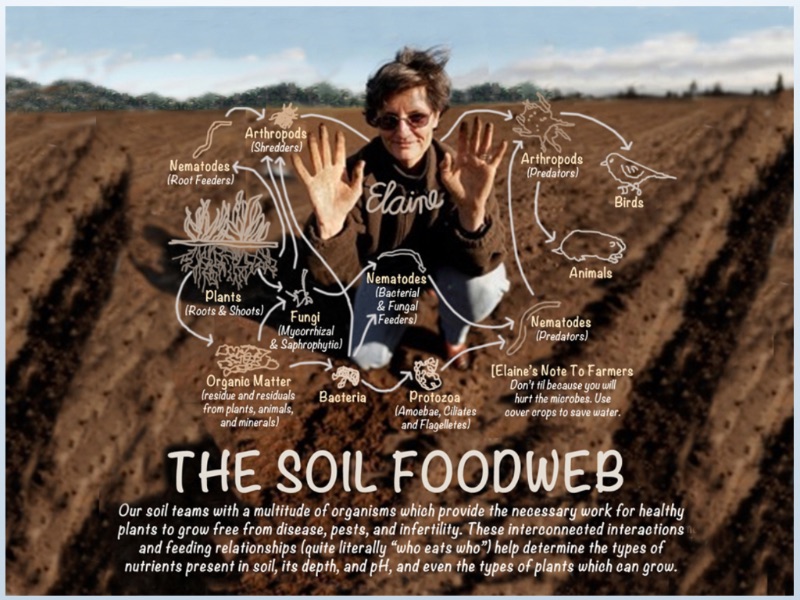
Elaine Ingham maintains an active schedule of classes and webinars focused on the most up-to-date knowledge about growing plants without pesticides or inorganic fertilizer.  Ingham consults and educates large scale commercial cotton and soybean growers, large scale berry growers, as well as large commercial fruit producers as well as shrimp production. Tune-In to learn about the great things Elaine is doing for the savior underfoot.
.
Ingham is well known for her work on the USDA soil-primer based on a concept she coined called the “Soil Food Web.”  Now, based on her decades of pioneering work as a soil microbiologist – Ingham has made it the objective of her company SoilFoodWeb.com to restore soil to its optimum state, anywhere at any scale.
.

What most may not know is about her efforts that saved humanity and all living planets on this planet.  You see…

.
“In 1992 the Environmental Protection Agency was only a few weeks away from ending life on the planet as we know it,” so writes George Lawton in the April, 2001 issue of Acres USA (“A Voice For Eco-Agriculture”).  Lawton reports that the EPA, although only having done limited tests at that time on a variety of genetically engineered microbes, all of which had been approved for release into the atmosphere, were prepared to approve the release of a GE variant of Klepsiella planticola (KP), one of the most common bacteria on the planet.
 .
“This particular variety of GE KP,” he writes, “had the unique ability to convert dead plant matter into alcohol. It was hoped that this would provide a way for farmers to transform their unused stalks, leaves and other types of compost material into alcohol, which could be used for washing, running vehicles. “
.
So, it’s worth giving a listen to our discussion to learn more about Elaine’s focus, her interests, and her scope on a stable and prosperous future from the ground up.

..


Dr. David Nabarro: World Health Organization ||

.

.

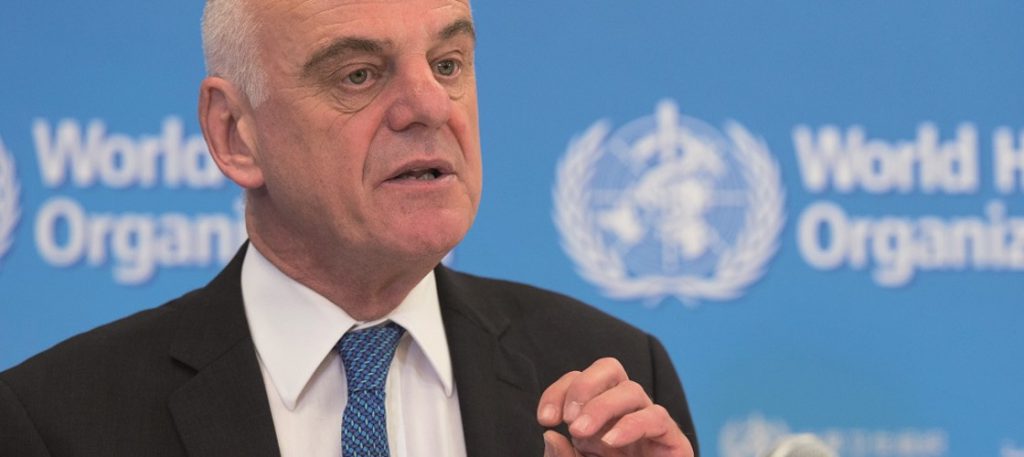
Dr. David Nabarro has spent 40 years progressing public, human and planetary health through diverse and far reaching initiatives.  Along with leading efforts to mitigate such epidemics as malaria, bird flu, ebola and cholera throughout the world, in his 20 years at WHO Dr. Nabarro has concentrated much of his powers on global food system reform.

Scaling programs for nutrient security in the developing world and responsible production in the advanced, Dr. Nabarro most recently helped lead the launch and implementation of the UN’s Sustainable Development Goals (SDGs) now impacting 1.5 billion around the globe.

episode 2:

Fred Kirschenmann – President of Stone Barns Board

On our second episode of Sourcing Matters podcast we welcome a founding father of American Organics, Fred Kirschenmann.  A true legend known for promoting regenerative agriculture and food system reform through commitment to soil health, Fred Kirschenmann is a Distinguished Fellow for the Leopold Center at Iowa State, and is President of the board at Stone Barns Center for Food and Agriculture in Tarrytown, NY.


QUICK GUIDE – this episode covers the following subjects:

  • regenerative agriculture is proper on-farm natural resource management
  • soil health harmonizes with gut health: microflora not too much different than soil
  • investing in soil health results in positive human & public health, planetary stability
  • a review of Organic standards – then and now
  • the future of hydroponics; should USDA Organic include growing in water?
  • urban agriculture has arrived, and is here to stay
  • the future farming workforce wants to grow food for each other, and not commodities

Sourcing Matters.show episode 2 recap:

Closing out 2017 we take a step back to evaluate the current state of Agriculture and regenerative natural resource management with a true expert in the field of future food, Fred Kirschenmann.   Hosts Aaron Niederhelman and Nathan Roman engage Professor Kirschenmann in a conversation of grave importance:  how do we feed ourselves on a shrinking planet?  And, how do we (re)establish food as our baseline for keeping ourselves and our planet in good standings.  ⇓

Throughout the 30 minute chat Fred offers unique insight earned from decades of fighting for a stable future. His most poignant description of Regenerative Agriculture may be the best ever captured.  Citing Sir Albert Howard’s law of return, Kirschenmann concisely describes regenerative as a process where “everything is renewed in the process of using it.”  Kirschenmann goes on to explain that “there are more microbes in a tablespoon of soil than there are humans on the planet!”  We learn that the impact of this has yet to be levered in modern food systems.  In fact, the vast majority of production in the developed world is based on an input-based approach where we’re not properly using this (free) microbial army to cycle nutrients for our benefit.  Instead, for purpose of creating empty cheap energy for more consumers to nosh, we’ve perpetuated an extractive approach in agriculture that is based on cheap petrochemicals, unlimited access to minerals and unlimited water which cannot be sustained.  


“As we look at our future, and we don’t have cheap energy to transport and grow food from thousands of miles a way – we’ll see more food grown within bio-regions.”


Kirschenmann eloquently describes that for purposes of financial expense, or true cost of externalities, or even capacity to maintain nevermind scale a production model past a ceiling fast approaching – feeding a growing population on a shrinking planet will come only from better understanding and engagement of regenerative natural resources.

To reduce the potential of continuing an industry food fight – Kirschenmann is nothing but pragmatic.  Through a process of diplomacy leaders in DC should evaluate – Fred describes how he empowers even the most staunch conventional producers to see the light of investing in soil vitality.  By justifying his argument with numbers that back increased demand for alternatively produced crops; and on the other side of the ledger – the increased costs and commitment requirements for maintaining status quo of conventional production; and even further, the realization of externalities and true costs associated to modern agriculture on human & environmental health – he makes it clear the only future of food production is regenerative.   


Digging deeper – investing in soil health does not only benefits the bottomline, it directly benefits your health and enjoyment of food.  Hear how Kirschenmann describes the diverse benefits of whole food from health soil.  From the cause & effect of changing diets and improving health in inner city communities – to supercharging the plates of the world famous chef Dan Barber – we must come out this half hour enlightened, and asking how revolutionary this could be in stabilizing our shared planet.  Maybe it’s us, the consumer, that can move the needle.  What if this approach was to be exercised through proper channels?  Could well sourced food from healthy soil be the silver bullet diet that a marketplace desperately seeks with billions of dollars every year?   

Hear what Fred has to say about this…

As the man who wrote the original rules on Organics, Fred Kirschenmann shares his thoughts on the recent ruling by the National Organics Standards Board to allow hydroponics to don a USDA Organics Certification. Fred offer a masterful description the benefits of food grown in water, and the vast market opportunities that will arise with further commitment.  But, after hearing the original intent pennded for Organics – it’s obvious there’s only one proper step forward here, and we may have just gone backwards.


In this chat Kirschenmann describes some of his recent experiences with the future workforce that’s more interested in “growing food for people, than corn or soy in Iowa”. Through his work at Stone Barns in Tarrytown, NY, and the Leopold Center at the Iowa State University, Kirschenmann is front and center in negotiating our shared future with the realities of planetary boundaries and evolving consumer interests.

The time is now for us to act, to innovate and to listen to what consumers and the future workforce seek from their food.